
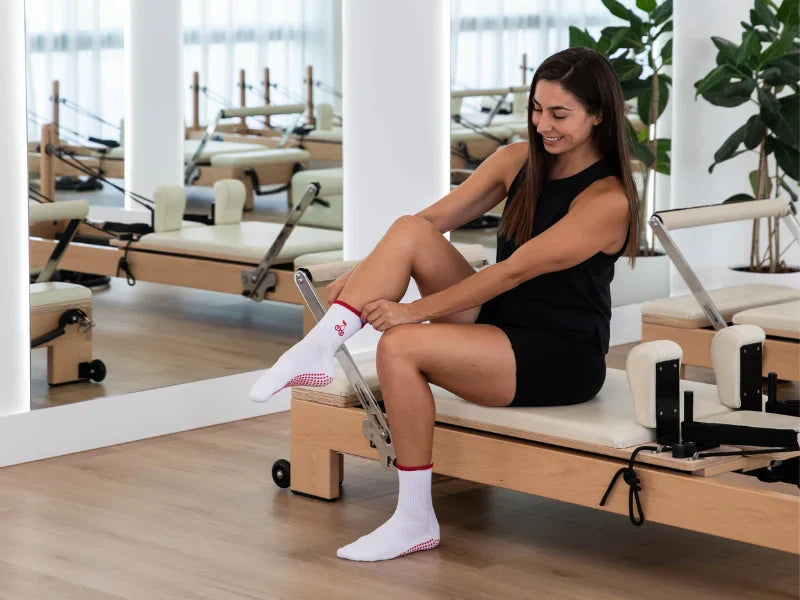
Why Reformer Pilates Studios Require Grip Socks
If you've booked your first Reformer Pilates class and the studio's website says to bring grip socks, that's not a suggestion. Most Australian studios treat it as a non-negotiable, and a number of them will ask you to sit out or buy a pair at reception before they'll let you on the reformer. Here's why the policy exists and what you actually need to know before you go.
The reformer is a shared, smooth, moving surface
Understanding why grip socks are required starts with understanding what the reformer actually is. The reformer is a machine with a padded sliding carriage, a footbar, springs and straps. The carriage moves. The footbar is smooth. The surfaces your feet make contact with throughout a session are not designed to grip bare skin or regular socks, and they become less forgiving as your feet warm up and start to sweat.
Exercises on the reformer involve footwork on a moving carriage, standing balance work, lunges with one foot on the carriage and one on the footbar, and dozens of other positions where a slip doesn't just break your concentration but can cause a real injury. Grip socks with full sole silicone dots create the traction that keeps your feet anchored to whatever surface they're on throughout those movements, regardless of sweat or position.
This is why the requirement exists. It's a safety standard, not an upsell.

The hygiene side of it
The second reason studios enforce the grip sock rule is hygiene, and it's a straightforward one. A reformer studio runs multiple classes every day across the same equipment. The carriage, the footbar, the shoulder rests and the straps are all touched and contacted by many different people before any cleaning between sessions. Grip socks act as a barrier between your feet and those surfaces, which reduces the transfer of bacteria, sweat and skin cells in both directions: protecting you from whatever was on the equipment before you and protecting the equipment from what's on your feet.
Studios that have a mandatory grip sock policy are essentially enforcing the same standard as gyms that require you to use a towel on shared equipment. It's about keeping a shared space usable and hygienic for everyone who trains there.
What happens if you show up without them
It depends on the studio, but the most common outcomes are that the studio will sell you a pair at reception for somewhere between $15 and $25, or they'll ask you to reschedule. A small number of studios will allow you to train barefoot if you've genuinely forgotten, but this is increasingly rare as the mandatory policy has become standard across most Australian Reformer Pilates studios. The safest assumption before your first class is that you need them, because the cost of being turned away or having to buy an emergency pair at the door is higher than simply sorting it beforehand.

Can you wear regular socks instead
No, and most studios specifically prohibit it rather than just discouraging it. Regular socks have no traction on the reformer surface and become actively dangerous once your feet start to sweat. The grip dots on a Pilates-specific sock are what make the difference between a foot that stays where you put it and one that slides mid-exercise. A regular cotton or bamboo sock feels fine on the floor before class and becomes a liability the moment you're doing footwork on a moving carriage.
What to look for in a grip sock for Reformer Pilates
Not all grip socks are the same and the reformer is one of the environments where the difference is most noticeable. Here's what matters:
Full sole grip: The grip dots need to cover the entire bottom of the sock, including the arch and midfoot, not just the heel and toe. The reformer footbar makes contact with different parts of the foot depending on the exercise, and a partial-grip sock leaves gaps that show up at exactly the wrong moment.
Snug fit: A sock that fits properly moves with your foot rather than around it. If there's excess fabric bunching at the toes or heel, the dots lose full contact with the surface and the traction becomes inconsistent. Cheeky Winx grip socks are made from a cotton and spandex blend with arch ribbing for a secure, stable fit that stays in place through a full session.
Breathable material: Pilates studios are warm environments and a session that looks low-impact generates real heat. A breathable cotton blend keeps your feet comfortable throughout without the stuffiness that synthetic materials can create.
Browse the full Cheeky Winx grip sock range across ankle, crew and frilly styles to find the pair that suits how you train and what you want to wear to class.

Do you need grip socks for mat Pilates too
Mat Pilates has a different policy landscape to Reformer. A lot of mat-based studios and home practitioners do mat Pilates barefoot because the mat itself provides traction and the floor-based exercises don't involve the same sliding surfaces as the reformer. That said, grip socks work perfectly well for mat Pilates and are worth having if you're ever doing mat work on a studio floor rather than a mat, or if you do both reformer and mat classes and want one pair of socks that works for everything.
Frequently asked questions
Are grip socks mandatory at all Reformer Pilates studios in Australia?
At most Australian studios, yes. The policy varies slightly from studio to studio, but the default assumption should be that you need them before you arrive. Checking the studio's website or booking confirmation before your first class will confirm their specific policy, but turning up with a pair is always the safer call.
Can I use the grip socks I already own for other workouts?
Yes, as long as they have full sole grip dots and fit properly. Grip socks designed for Pilates work across barre, yoga, group fitness and any studio-based training. The Cheeky Winx range is designed specifically for studio use across all these formats.
What if I forget my grip socks on the day?
Most studios sell grip socks at reception, usually at a higher price than you'd pay buying your own in advance. If your studio doesn't sell them and doesn't allow barefoot training, you may need to reschedule. It's worth keeping a spare pair in your bag so this situation doesn't come up.
Why can't I just go barefoot if I prefer it?
Most Reformer studios don't allow it for the same reasons they require grip socks in the first place: safety on moving surfaces and hygiene on shared equipment. Bare feet offer no consistent traction on the reformer carriage and no hygiene barrier on shared surfaces. Even if going barefoot feels natural for other types of training, the reformer environment is different enough that the policy makes sense.
How many pairs of grip socks do I need for Pilates?
If you train two or more times a week, having two to three pairs in rotation is the practical minimum. It means you always have a clean pair ready and each pair lasts longer because it goes through fewer wash cycles. Browse the Cheeky Winx grip sock collection to stock up across different styles and designs.
Do grip socks make a noticeable difference to the quality of your Pilates session?
Yes, and most people notice it immediately. The stability that comes from proper traction on the reformer means you can focus on the exercise rather than managing your footing. For beginners especially, grip socks remove one variable from an already complex environment and let you concentrate on what the instructor is telling you rather than whether your foot is about to slide.
If you're heading to your first Reformer class or looking to replace an old pair, browse the full Cheeky Winx grip sock range and find the style and design worth bringing to every session.

Leave a comment
This site is protected by hCaptcha and the hCaptcha Privacy Policy and Terms of Service apply.